
Romblon’s Marble Industry Explained
Discover Romblon’s legendary marble heritage and thriving stone industry today.
Romblon marble industry
The Hidden Gem of Philippine Stone Quarrying
When you think of marble, images of Italian quarries or Greek sculptures probably come to mind. But tucked away in the Philippines, the island province of Romblon has quietly built one of Asia’s most impressive marble industries. More than 60 percent of the country’s marble production happens right here, transforming small fishing communities into bustling centers of stone craftsmanship.
Walk through the capital town of Romblon, and you’ll see marble dust coating the streets like snow. The sound of chisels hitting stone echoes from workshops scattered across the island. This isn’t just an economic activity—it’s woven into the identity of the people who live here.
A Legacy Built on Stone
The marble industry in Romblon didn’t emerge overnight. Local quarrying began in earnest during the early 20th century when entrepreneurs recognized the quality of the island’s white and colored marble deposits. Over decades, small-scale operations grew into sophisticated quarries and processing facilities.
Today, Romblon marble is known for its purity and workability. The white varieties particularly command respect in both domestic and international markets. What makes Romblon marble special is its fine grain structure, which allows artisans to create intricate carvings and detailed architectural pieces that would crack or shatter if attempted with lower-quality stone.
Where the Quarries Are Located
The main marble quarries cluster around specific barangays. Barangay Calatrava is home to some of the oldest and most productive quarries on the island. If you’re visiting, you can access this area by taking a tricycle from the town proper for approximately 150 pesos, a journey of about 20 minutes.
Barangay San Fernando also hosts significant marble operations, with several quarries operating there. The quarries themselves typically don’t charge visitor entrance fees, though it’s respectful to ask permission from site managers before exploring. Many quarry operators are welcoming to tourists genuinely interested in learning about their work.
The Extraction Process
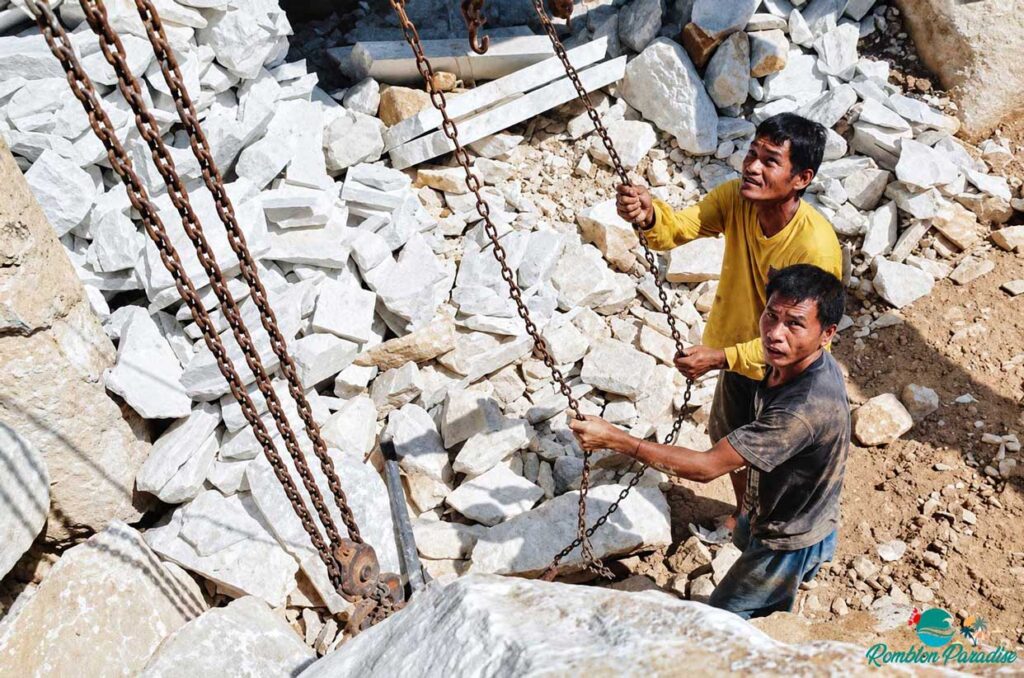
Watching marble extraction is surprisingly fascinating. Workers use a combination of traditional hand tools and modern machinery to cut blocks from the quarry face. The process begins with drilling holes into the marble seam, then inserting wedges to split massive blocks free from the mother rock.
Once extracted, these rough blocks are transported to processing centers. Here, large diamond-blade saws slice them into thinner slabs. The dust from cutting is collected and sold separately for use in tiles, terrazzo, and other products—nothing goes to waste in this industry.
The final step involves polishing and finishing. Artisans use increasingly fine-grit sandpaper and polishing compounds to achieve the lustrous surface that makes Romblon marble so prized. Some pieces are left with a honed finish for architectural applications, while others receive a high-gloss polish for decorative items.
Products and Applications
You’ll find Romblon marble in churches, government buildings, and private homes throughout the Philippines. It’s used for flooring, wall cladding, countertops, and sculptural pieces. The island also produces decorative items like vases, bowls, and figurines that appeal to both local buyers and tourists.
International export is significant too. Marble slabs and finished products ship to Southeast Asia, the Middle East, and occasionally to North America. A standard marble slab roughly one meter by two meters might cost between 8,000 to 15,000 pesos depending on thickness and finish quality, though prices fluctuate based on market demand.
The Economic Impact on Local Communities
For thousands of Romblonians, marble work is the primary livelihood. Quarry workers, equipment operators, truck drivers, and artisans all depend on this industry. Beyond direct employment, marble processing supports related businesses—tool suppliers, transport companies, equipment dealers, and restaurants serving the workforce.
The industry also attracts skilled workers from other provinces. Some have relocated permanently to Romblon, bringing their families and integrating into local communities. This migration has helped maintain steady labor supply despite the physically demanding nature of quarrying work.
Visiting Romblon and Experiencing the Industry
If you want to see the marble industry firsthand, plan for at least a day trip or better yet, an overnight stay. The best time to visit is during the dry season, from November to May, when road conditions are optimal and quarry operations run at full capacity.
To get there, fly into Caticlan Airport or Roxas, Capiz, then take a ferry to Romblon. From Manila, the ferry journey takes approximately 10 to 12 hours. Ferry fares typically range from 600 to 1,500 pesos depending on the vessel class. Once on the island, tricycles are your best bet for local transportation.
Several workshop owners welcome visitors. Plan to spend 2 to 3 hours watching artisans at work. Bring comfortable shoes and a light scarf to protect against marble dust. Many workshops are happy to show you the entire process, from raw blocks to finished pieces. Some sell directly to visitors at prices lower than retail shops.
The Craftsmanship Behind the Stone
What strikes most visitors is the level of skill required. Master carvers can spend decades perfecting their craft. They read the stone intuitively, understanding grain patterns and potential weak points. A single intricate carving might take weeks to complete, with the artist working in dim workshops illuminated by natural light and simple work lamps.
Younger generations are learning these skills through apprenticeships. Family-run businesses often pass knowledge from parents to children, maintaining techniques that might otherwise disappear as manual craftsmanship becomes less common globally.
Environmental and Sustainability Considerations
Large-scale quarrying does leave visible marks on the landscape. The Romblon provincial government has implemented regulations requiring quarry operators to maintain safe working conditions and manage waste responsibly. Rehabilitation of exhausted quarry sites is an ongoing conversation among industry stakeholders and local officials.
Water management is crucial in marble processing. Processing facilities require significant water volumes for cutting and polishing. Responsible operators recycle water and treat discharge to minimize environmental impact, though oversight varies across different operations.
Common Questions About Romblon’s Marble Industry
Can I buy marble directly from quarries or workshops? Yes, many operators sell directly to visitors. Expect to negotiate prices for bulk purchases. Smaller decorative items typically sell for 500 to 5,000 pesos depending on size and intricacy. Shipping arrangements can be made for larger pieces.
Is it safe to visit active quarries? Most quarries are safe for visitors during daylight hours if you follow workers’ instructions. Wear closed-toe shoes and avoid standing directly under overhead operations. Ask permission first and respect any restricted areas.
What’s the best marble product to buy as a souvenir? Smaller carved pieces like figurines or boxes are practical. They’re lightweight enough to transport, represent authentic local craftsmanship, and make meaningful gifts. Prices range from 300 to 3,000 pesos for quality pieces.
Planning Your Marble Industry Visit
Before traveling, contact the Romblon Provincial Tourism Office to confirm which quarries and workshops currently welcome visitors. Bring cash—many operations don’t accept cards. Pack sunscreen and a hat, as quarry areas offer minimal shade. If you’re serious about purchasing marble pieces for shipping, bring measurements and specifications of what you need.
The marble industry remains vital to Romblon’s economy and identity. Whether you’re a curious traveler, a builder seeking quality stone, or someone fascinated by traditional craftsmanship, experiencing this industry firsthand reveals why the island earned its reputation as the marble center of the Philippines.