
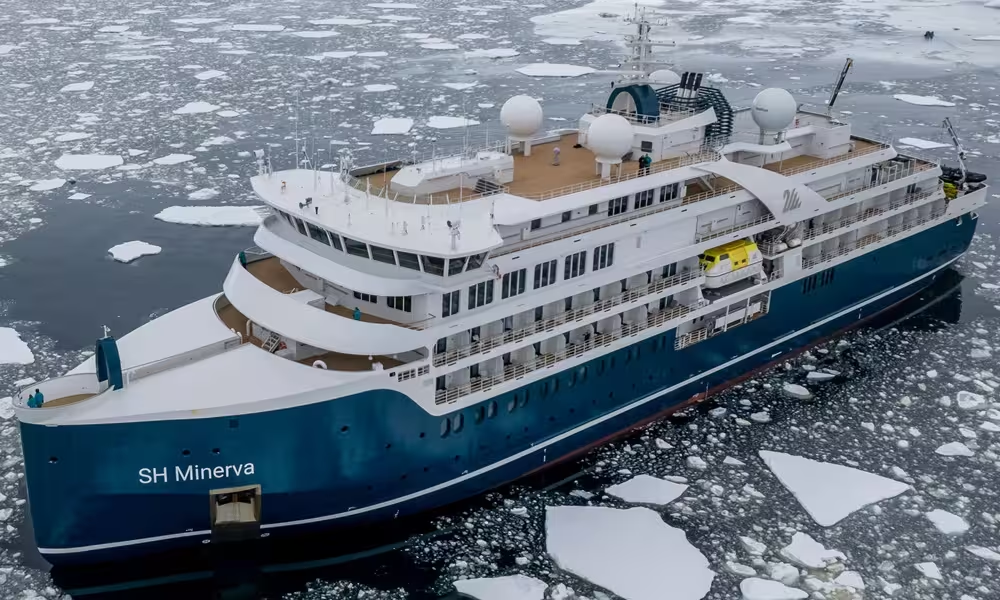
Cruise Ship SH Minerva Arrives in Romblon, Romblon: Putting the Marble Capital on the Global Cruise Map
Travel & Maritime News | May 2026
The province of Romblon has long existed on the periphery of mainstream Philippine tourism — a destination known chiefly to divers, heritage hunters, and those willing to endure a fourteen-hour ferry crossing from Batangas. That deliberate obscurity is now changing. In a development that signals a broader pivot in expedition cruising toward the Philippine archipelago, the luxury expedition vessel SH Minerva, operated by Swan Hellenic, has made a port call in Romblon, Romblon — placing this marble-rich island province firmly on the international cruise map.
The Vessel: What the SH Minerva Represents in Expedition Cruising
To understand why this arrival matters, one must first understand what the SH Minerva is — and what it is not.
Built in 2021 at the Helsinki Shipyard in Finland, the SH Minerva is not a floating resort in the tradition of mega-ships designed for the Caribbean circuit. She is an intimate, PC5 ice-classed expedition vessel, purpose-built to carry a maximum of 152 passengers into some of the planet’s most inaccessible waters. Her hull was engineered to push through Antarctic pack ice. Her nine decks accommodate a dedicated crew of 120, whose sole focus is curating immersive experiences for a small, carefully self-selected group of travelers.
The ship features 76 staterooms fitted with panoramic windows, private balconies, and — in the flagship suites — flame-effect fireplaces. An open-deck jacuzzi, infinity pool, panoramic sauna, state-of-the-art gym, and world-class restaurant complete the picture of a vessel that straddles the line between polar explorer and boutique luxury hotel. Crucially, the SH Minerva is designed not for passengers who want to see the world from a pool deck — but for those who want to step into it.
Her maiden voyage departed from Ushuaia, Argentina in December 2021, bound for Antarctica. Since then, she has become one of the most acclaimed small expedition ships in the world. Following the conclusion of the Antarctic 2025–2026 season, Swan Hellenic launched its first dedicated Asia-Pacific expedition program aboard the SH Minerva in early 2026, threading through the Solomon Islands, Papua New Guinea, Indonesia’s Raja Ampat archipelago, the Philippines, and Japan. Romblon is not a footnote on this itinerary. It is, by design, one of its signature stops.
Why Romblon? The Strategic Logic Behind the Port Call
Swan Hellenic’s selection of Romblon as a Philippine port of call is not accidental — it reflects a deliberate curatorial philosophy that prizes undiscovered authenticity over the well-worn. While Manila offers logistical convenience and Coron offers visual spectacle, Romblon offers something rarer in the modern era of mass tourism: genuine encounter.
Known as the Marble Capital of the Philippines, the province accounts for approximately 80 percent of the country’s marble production. Its deposits — including varieties of Carrara-white, Romblon Rosso, deep-veined Black Marquina, and Verde Antique — have been quarried and crafted since the Spanish colonial period, when local artisans were employed to carve marble adornments for the earliest churches in the archipelago. The tradition has never stopped. Walk through Romblon town today and you will find workshops where craftsmen shape marble by hand into sculptures, tiles, and domestic objects, passing techniques across generations without interruption.
That continuity — of craft, of culture, of landscape largely untouched by resort infrastructure — is precisely what expedition cruise operators seek when building a premium itinerary. SH Minerva’s passengers are not looking for a beach club with a swim-up bar. They are looking for Fort San Andres, one of the Philippines’ most significant surviving Spanish-era coastal fortifications, its coral-stone walls standing nearly four centuries after its construction to defend the island from Moro raiders. They are looking for the St. Joseph Cathedral, a National Cultural Treasure declared in 2001, whose interior altar is built of locally quarried marble and whose foundations predate most colonial architecture in the Visayas. They are looking for the artisan quarter, the harbor light, and a town that has not yet recalibrated itself for social media performance.
The Arrival: Economic and Cultural Significance
Provincial Tourism Officer Kim Faderon confirmed in March 2026 that both the SH Minerva and the MS Amadea are scheduled to dock in Romblon as part of their Philippine itineraries. Combined passenger arrivals from both vessels are estimated to bring approximately 500 foreign tourists ashore within the season — a figure that carries significant weight for a province whose economy has historically depended on fishing, marble quarrying, and coconut farming.
The economic logic is straightforward. Expedition cruise passengers spend more per capita than conventional tourists. They are typically older, affluent, and actively seeking to purchase artisanal goods and engage with knowledgeable local guides. The marble workshops and souvenir shops of Romblon town — offering hand-carved products from small keepsakes to full furniture pieces — are precisely the kind of local commerce that benefits most from this demographic. Unlike budget travelers who move quickly through a destination, expedition cruise passengers arrive briefed by onboard specialists, carrying context, curiosity, and genuine purchasing intent.
Beyond commerce, there is a symbolic dimension that should not be underestimated. International expedition cruise lines operate on hard-won reputations built over decades. When Swan Hellenic places Romblon on the same itinerary as Raja Ampat and the Batanes Islands — both regarded internationally as among Southeast Asia’s premier wilderness and cultural destinations — it sends an unmistakable signal to the global travel industry: Romblon belongs in that conversation.
What Romblon Offers the Expedition Traveler
For those unfamiliar with the province, a brief accounting of its natural and cultural assets clarifies why it merits this level of international attention.
Romblon is composed of three major islands — Tablas, Sibuyan, and Romblon Island itself — along with 17 smaller islets, each ecologically and culturally distinct. Sibuyan Island, frequently referred to as the Galápagos of Asia, is home to Mount Guiting-Guiting, a 2,058-metre peak whose infamous approach ridge — locally called the Knife Edge — has earned a reputation as one of the most technically demanding climbs in the Philippine archipelago. Its old-growth rainforest ecosystem supports a remarkable density of endemic species and has drawn the attention of international conservation biologists.
In and around Romblon town, the marine environment rivals the most celebrated dive sites in the Visayas. The Blue Hole and Agnay Sanctuary offer coral garden formations and encounters with rare pelagic species, including the blue-ringed octopus — a creature that draws specialist divers from across the world specifically to these waters. Bonbon Beach, with its dramatic low-tide sandbar connecting to a neighboring island, has been listed among the world’s top-50 beaches. Cresta de Gallo, a remote sandbar accessible only by small boat, represents the kind of pristine, crowd-free natural experience that is becoming genuinely scarce across Southeast Asia.
The province’s food culture is an understated asset. Sarsa — a fragrant coconut milk broth with chili and freshwater seafood — reflects the culinary intelligence of an island people who have cooked with what surrounds them for centuries. Fresh-caught squid and crab, prepared simply and sourced that same morning from the surrounding Sibuyan Sea, represent the provenance-driven cuisine that discerning expedition travelers increasingly seek and value.
The Bigger Picture: Philippine Ambitions in Expedition Cruising
The SH Minerva’s arrival in Romblon should be read against a backdrop of growing international interest in the Philippines as a premium expedition cruise destination. The country’s geography — more than 7,600 islands, one of the longest coastlines in Asia, and extraordinary marine biodiversity — has always made it a logical candidate for this market. What has historically limited deeper integration into international expedition itineraries is a combination of port infrastructure gaps and the limited global visibility of less-developed provincial destinations.
That equation is shifting. The arrival of an operator of Swan Hellenic’s caliber in a province like Romblon is not just a tourism win — it is a proof of concept. The SH Minerva does not dock at just any port. Its itinerary selections reflect rigorous evaluation of logistical practicality, ecological sensitivity, and experiential depth. Romblon passed that evaluation.
For local and provincial authorities, the challenge now is to build on this momentum responsibly: investing in maritime infrastructure, training guides fluent in the province’s history and ecology, and establishing frameworks that ensure tourist spending circulates within the local economy rather than flowing to outside operators.
Conclusion: A Port Call, and a Turning Point
The SH Minerva’s arrival in Romblon, Romblon is a modest event in the global maritime calendar. At most, 152 passengers step ashore. A few hours — perhaps a full day — of exploration follows. Then the ship weighs anchor and continues its course northward.
But these small events compound over time. They generate photographs that circulate internationally. They produce travel dispatches filed by passengers who are, by virtue of their demographic profile, disproportionately influential in the circles where significant travel decisions are made. They demonstrate to operators planning future itineraries that Romblon can receive international visitors with depth, grace, and authenticity.
More than anything, this port call affirms what those who have visited Romblon have long known: that this province — with its marble-dusted workshops, centuries-old fortifications, pristine coral reefs, and unmarked beaches — belongs not on the margins of Philippine tourism, but at its most compelling edge. The place where beauty has not yet learned to perform for an audience.
The SH Minerva, a ship purpose-built to find exactly such places, seems to agree.
For tourism inquiries about Romblon Province, visit the Romblon Provincial Tourism Development and Cultural Office.
Tags: SH Minerva, Swan Hellenic, Romblon tourism, Philippines expedition cruise, Marble Capital Philippines, cruise ship Philippines 2026, Asia-Pacific cruise itinerary, Romblon Romblon travel